Thursday, July 28, 2011

Among Polynesians; Kon-Tiki by Thor Heyerdahl. Antecedent

The Kon-Tiki expedition ended when the Kon-Tiki shipwrecked on the Raroia reef. After about a week, the native peoples found and got to know the Kon-Tiki crew. The native people hosted many celebrations in honor of the crew, who proved the existence of the tribe's ancestor Tiki. Finally the crew and the Kon-Tiki were taken by the "Tamara" to Tahiti where they could be taken back to their respective homes.  "But the six of us on deck, standing beside our nine dear balsa logs, were grateful to be all alive. And in the lagoon at Tahiti six white wreaths lay alone, washing in and out, in and out, with the wavelets on the beach." This quote expresses feelings of the departure of the Kon-Tiki crew from Tahiti after their long expedition across the pacific. Here the crew was being taken by a Norwegian steamer, Thor I,back to America. In this quote, Heyerdahl expresses how leaving Tahiti was a bittersweet goodbye by mentioning the six wreaths in the lagoon. In Tahiti, leaving a wreath in the lagoon upon departure is a tradition showing that the departing would like to come back to Tahiti. Although departing from  Raroia would have been sad, departing from Tahiti would mark the end of a lifestyle that the crew had developed over the past few months. Stepping on the steamer took the crew out of the ancient way of life and back into the present time. The connections with ancient peoples and nature were broken by the steamer that, instead of working with the ocean's natural currents, pushed through them in typical modern day style.

The crew probably left the lagoon of Tahiti with mixed emotions. Pride was probably felt for accomplishing the expedition that so many people deemed impossible. Relief was probably felt in knowing that all the members of the crew had made it across the sea alive and mostly unharmed. Joy was probably felt knowing that the crew would soon be able to see family and friends. In contrast, the crew was probably saddened knowing that they were leaving both the new friends they had made and the place they had called home for so many months. As William Shakespeare once wrote, "All good things must come to an end."


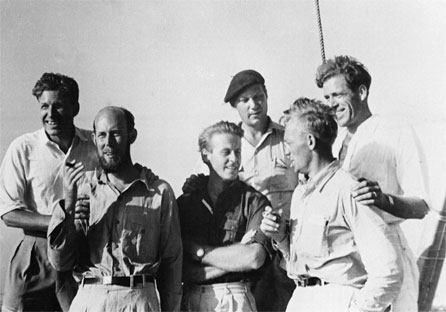
This is a picture of the Kon-Tiki crew dressed for celebration.


"Waves were breaking out on the blue sea. We could no longer reach down to them." Here, waves is the antecedent to them.

Wednesday, July 27, 2011

To the South Sea Islands- part two: Kon-Tiki by Thor Heyerdahl. Diction

"Then the great wave reached them, and we had all one single thought- hold on, hold on, hold, hold, hold!" After the Kon-Tiki drifted away from Angatau, the crew decided to sail to the next closest island, which unfortunately was surrounded by two great coral reefs. And, although the crew tried desperately to steer clear of the reefs, the wind pushed them directly toward the Raroia reef. Without any other choice, the crew braced themselves to cross the reef, which was a dangerous task. In the quote above, Heyerdahl expresses the difficulty and danger of crossing the reef, as well as the desperation to survive crossing the reef. All the members of the crew were holing tight to the raft for dear life. The crew must have had an extremely strong desire to finally make it to land, but an even stronger desire to make it to land alive.  After fighting their way through the coral reef, the crew waded their was across the water to land. This must have felt like heaven to the crew who had been at sea for 101 days. The crew probably felt relieved, safe, and proud for accomplishing something that so many people told them would fail. This crew gives a perfect example of staying firm in your beliefs no matter what life throws at you.


 This picture is that of the Kon-Tiki after it crossed the Raroia reef.


When Heyerdahl wrote, "hold on, hold on, hold, hold, hold!", the diction he used was to put emphasis on the importance of holding on to the raft in order to preserve the crew members' lives.

To the South Sea Islands- part one: Kon-Tiki by Thor Heyerdahl. Onomatopoeia

"Land! An island! We devoured it greedily with our eyes and woke the others, who tumbled out drowsily and stared in all directions as if they thought our bow was about to run on to a beach." Heyerdahl and his crew after many months at sea finally spotted land, as stated in the quote. I cannot imagine the relief they must have felt knowing that they were not just drifting aimlessly in the Pacific. The island that the crew saw was Puka Puka, and even as enticing as this island may have seemed, the crew decided to continue sailing to Angatau.After three days the crew spotted their desired island. Although the crew was in sight of land they still had a problem: how could they make it to shore while avoiding the coral reef reefs? This must have been so hard for the crew to have been so close to land and still have to spend days on the raft trying to find a way to shore. To me this would be like holding candy in front of a small child each day for a week straight without letting the child eat the candy. While drifting around the coral reef trying to find a safe spot to cross, natives from the island came out on canoes to try to help the crew. After much struggle against the wind, the crew and the natives gave up the fight to cross the coral reef with the Kon-Tiki, which was drifting out to sea again. The crew was so close to finally ending their trip, but they could not fight the forces of nature which were blowing them away from the island. This must have been difficult to have seen a possible end to their journey slipping away from the Kon-Tiki crew.

"The breakers were silent; only the sea roared as it used to, and all the ropes on board the Kon-Tiki creaked and groaned." Here Heyerdahl uses onomatopoeia to describe the sounds the Kon-Tiki made.

Tuesday, July 26, 2011

Across the Pacific (Chapter 6)- part two: Kon Tiki by Thor Heyerdahl. Foreshadowing

"When the storm rushed up over the horizon and gathered about us for the first time, strained anticipation and anxiety were discernible in our looks." In this quote, Heyerdahl is describing the fear that he and his crew felt when their first storm arose at sea. The Kon-Tiki had been sailing for a few months at that point and they were just facing their first storm. More storms were to follow along with the impact of the storms on the Kon-Tiki. The storms had left the ropes on the raft stretched out and weak. This allowed for much more movement of the balsa logs, which could result in one of the crew members slipping between the logs and being crushed by them. During the storms, the crew tried to keep their raft in tact; however, Herman accidentally fell overboard while trying to save a sleeping bag. This was frightening because the strong waves made swimming back to the raft nearly impossible and made throwing a life-preserver completely impossible. Knaut swam into the sea with a life-preserver and helped Herman swim back to the Kon-Tiki. This experience was frightening for the crew, but it also reminded them to be cautious.

The events that took place during this section can teach us lessons in our own lives. No matter what we pursue in our lives, struggle is inevitable apparent by the crew facing the storms. We have to fight through this struggle in order to achieve our goals as shown by the crew keeping the raft in tact. And, no matter how long something "goes right", something can still "go wrong" as demonstrated by Herman falling overboard.

"And what happened in the new few second took a much shorter time than it takes to tell it." Here Heyerdahl is foreshadowing that Herman was about to fall overboard.

Monday, July 25, 2011

Across the Pacific (Chapter 6)- part one: Kon Tiki by Thor Heyerdahl. Jargon

"We realized that life had been full for men before the technical age also- in fact, fuller and richer in many ways than the life of modern man." I know how common technology is in the everyday lives of people today. People can get caught up in the latest trends and can want the newest innovation to date. I am not saying that technology is bad, but sometimes I know that I forget to respect and enjoy the simplicity of nature that surround me. I think that the quote above expresses Heyerdahl's realization of how wonderful nature really is. Heyerdahl related to the primitive peoples because they shared the common point of receiving joy from nature instead of technology. Although Heyerdahl was basically submerged into nature, he still was open to and accepted the joys from the ocean. Heyerdahl and his crew were given food and enjoyment from their surrounding ocean waters. An example of both was catching sharks with bare hands. The action of catching the shark provided entertainment while the shark meat provided food. Even though we may not be able to submerge ourselves into nature and fish for sharks with our bare hands, I think that we can all find time to stop and really take in the beauty of nature just as many have done before us. Nature connects us to those who have gone before us.

Heyerdahl and his crew uses the word "chips" to describe the measurement of speed that the raft passed a chip thrown ahead of the raft. The use of the word "chips" is jargon on board of the Kon-Tiki.


This is a picture of a shark caught by hand.

Sunday, July 24, 2011

Halfway- part two: Kon-Tiki by Thor Heyerdahl. Inference

 "But we did not really feel these enormous distances, for the horizon glided along with us unnoticed as we moved and our own floating world remained always the same- a circle flung up to the vault of the sky with the raft itself as center, while the same stars rolled on over us night after night." I think that this quote is effective in expressing how comfortable Heyerdahl and his crew are with being on the raft far out at sea. At this point on their expedition, the Kon-Tiki crew is about halfway to the Polynesian islands. Although they have encountered many different sea-creatures, they still come across new and somewhat frightening animals. An example of this would be the squid about which the crew was warned before they left on their expedition. This new sea-creature was unsettling at first, but like before, the crew became accustomed to squid. Although their expedition would seem long and potentially boring, the crew constantly kept busy with various tasks.The crew also found a way of entertainment and safety from a coconut crate, which they used to protect them while diving under the raft. The crew members could dive under the raft and examine more closely the animals surrounding them within the safety of the crate.
In my own life I know that I can and do grow accustomed to new things. In addition to this, I also know that even though I can be used to a certain setting, new and interesting things are waiting for me to do and explore within that setting. Sometimes the smallest things can be the most entertaining and interesting.

"If the baby could clamber on board, its hungry progenitor could no doubt do the same." Here, Heyerdahl was making an inference about the ability of a squid to come aboard the Kon-Tiki.

Halfway- part one: Kon-Tiki by Thor Heyerdahl. Simile

"It was so unusual to hear real breathing out at sea, where all living creatures   wriggle silently about without lungs and quiver their gills, that we really had a warm family feeling for our old distant cousin the whale, who like us had strayed so far out to sea." To me, this quote, like most of the first part of this chapter, expresses relationships between people and other animals. Although technology and lifestyles have since the time the primitive peoples traveled across the Pacific, Heyerdahl felt a connection to them while he was on the Kon-Tiki raft. Heyerdahl and his crew lived off the resources around them just as the primitive peoples would have long ago. The crew also felt a relationship to the animals around them. An example of this would be the whale mentioned in the quote above. This new found relationship came from the common diet of plankton. The crew began to gather and eat plankton, which was both appetizing and nutritious. The crew became upset with the fish who tore apart the mesh bag, which the crew was using to gather the abundant plankton, in order to obtain the plankton inside. The crew jokingly remarked that the fish should act more like the whale, who would fill his mouth and then blow the water out through his mustache. The subject of the whale evoked thoughts of another breathing animal out on the sea other than the Kon-Tiki crew.

"But, when we got hold of it, the pirates' treasure turned into millions of tiny glittering shrimps and phosphorescent fish larvae that glowed in the dark like a heap of live coals." Heyerdahl uses this simile to describe the plankton that his crew gathers for food.

Saturday, July 23, 2011

Across the Pacific (Chapter 4): Kon Tiki by Thor Heyerdahl. Irony

Sometimes in life, I have trouble starting new projects, papers, etc. This may be for fear of failure, a misunderstanding of what I am supposed to do, or in some cases writers block. However, I know that when I finally do get started, I can continue at a constant pace. "She did not hurry, but when she had once got going she pushed ahead with unshakable energy." This quote expresses how Heyerdahl viewed the start of the Kon-Tiki journey in a way that seemed inspirational. 

When the Kon-Tiki raft started its journey, it was towed out to sea to gain a better starting point. It began slowly, but with encouragement from the wind, it started to move more quickly at a constant pace. On their journey across the sea, the members of the crew encountered new creatures, which were both fascinating and sometimes frightening. Everyday on the Kon-Tiki was a new experience from which the crew learned. Although the crew did not know how to steer the raft, they quickly learned and became proficient at it.

In life, people can need help getting started on a successful path as well as encouragement to continue the path they had been helped to start. Each day can bring new experiences in our lives from which we can either learn and apply in our future, or ignore because we believe to be of no practical use in our lives. Experiences in our lives can frighten us, but this is part of life that can teach us lessons. We should not give up our planned journey for fear of failure or anything else. We should continue our journey and learn from these experiences even when we don't know what we are doing at first.

When the Kon-Tiki was being towed out of the harbor, the situation was ironic because the crew members, excluding Heyerdahl, were accidentally left behind on the shore.

Wednesday, July 20, 2011

To South America- part two; Kon-Tiki by Thor Heyerdahl, Concrete Details

"...we were thoroughly tired of stone and solid earth and wanted to sail out and get to know the sea."
This quote more blatantly shows how eager Heyerdahl was to begin his expedition.

Beaches can be crowded. Between the lengths of boats and shipyards to the sun bathers and beach goers, the beach seemed to be an unsuitable place for Heyerdahl to build his raft. With this in mind, Heyerdahl asked and received permission from the President of Peru, Don Jose Bustamante y Rivero, to build his raft in the Naval Harbor. Heyerdahl and his crew were frequently having trouble with the aspect of legalities and the paperwork to go along with their expedition; however, the crew was able to build their raft as a faithful copy of the old vessel. Heyerdahl asked people to take a look at his raft, and the results were not what he expected. After listening to multiple people's words of discouragement, one can feel doubt in the adventure he is about to partake in. Heyerdahl must have felt doubt about his expedition after listening to person after person telling him that his expedition would fail. Each person came up with different reasons why a primitive balsa-wood raft would fail. Heyerdahl was even begged not to go on his expedition, but he continued his journey anyway.
Heyerdahl and his crew finished some of the final touches to the raft such as making space for personal items and loading the food rations onto the raft. Before the crew set sail, they christened their raft with coconut milk as Kon-Tiki after the story of the sun-king who sailed from Peru to Polynesia 1,500 years ago. Heyerdahl and his crew were ready to begin their journey.


When describing the building of the raft, Kon-Tiki, Heyerdahl used concrete details.

To South America- part one: Kon-Tiki by Thor Heyerdahl. Personification

"We had reached the country where the balsa tree grows and were to buy timber to build our raft."
I think this quote subtly shows Heyerdahl's excitement to begin his expedition.

Imagine spending months planning for something only to find out that at the planned time and place, something has gone wrong, and plan B has to be put in effect. The only problem is that you haven't made a plan B, and you are in a foreign country. This is pretty much what happened to Heyerdahl when he arrived in South America to buy balsa-wood to make his raft.

Heyerdahl and Watzinger flew to South America with a plan that they would go to a lumber yard and buy logs of balsa-wood. However, when they arrived they found that balsa-wood could not be bought from the lumber yards in whole logs. Another problem that the two faced was that they had arrived in Ecuador just after the rains had begun. This caused problems for Heyerdahl's plan to go inland and fell the woods himself because the mud from the rain made traveling from the coast through the jungle impossible. Thinking quickly on his feet, Heyerdahl then devised a plan to fly to a city called Quito that was located on the Andes range and then to come straight down from the Andes to the inland side of the jungle where Balsa trees were located. This plan would bypass traveling through the dangerous, muddy jungle.

The jungles presented their own problems and dangers. the dangers include:
  • dangerous mud
  • torrential rain
  • snakes
  • scorpions
  • other tropical animals
  • head-hunters
Yep, Heyerdahl and Watzinger were warned about head-hunters who would kill to take heads, shrink them, and sell them to tourists. Luckily, Heyerdahl and Watzinger didn't come into contact with the head-hunters.
 However, when in the jungle cutting down balsa trees, Watzinger was bitten by a Kongo ant, which made him sore but was not detrimental to his health.

Heyerdahl and Watzinger along with the help of native Indians were successful in cutting down usable balsa trees. Each tree was named in in honor of Polynesian legendary figures before being cut down completely. a total of twelve mighty trees were cut to use for the balsa raft. The wood was transported downstream to Guayaquil, where Watzinger and Heyerdahl were to part in order to perform assigned tasks to build the raft.

When Heyerdahl was explaining arriving in the forest village in the jeep he said, "Then the jeep had a puncture and went down on one knee." This is an example of personification because jeeps do not have knees.

Tuesday, July 19, 2011

An Expedition is Born: Kon Tiki by Thor Heyerdahl. Limited narrator

 "We had an unspeakable feeling of relief that the first stage of the program was over and that we were now going straight ahead to the adventure."
I think that this quote is helpful in expressing how difficult planning an expedition was for Heyerdahl and that he was excited for the actual adventure and really did not care for the planning of it.

Rejection can be a sore subject for any person, especially when one is not even given the opportunity to argue his position. However, rejection can lead to new ideas supported by close friends. Plans grow in strength with more support and acceptance. Sometimes financial support is needed for a plan to turn into action. Through the process of planning, a close companion can mitigate and make more enjoyable the burden of extensive planning.

In Kon-Tiki, Thor Heyerdahl's ideas were rejected when presented to specialists, who would not even read past the title of his manuscript. Heyerdahl, when talking with a friend, then devised a plan to sail across the Pacific on a balsa-wood raft as the primitive peoples would have long ago according to his theory. He spoke with sailors to learn more about navigating the sea. Heyerdahl also began to recruit support for his expedition by talking to close friends and colleagues about the possibility of his proposed expedition. Then, Heyerdahl needed to elicit supplies and financial support from any generous sponsor.During the process of finding supporters, Heyerdahl found an adventurer Herman Watzinger who would become his close companion. Heyerdahl continued to find supporters, some who would join him on his expedition, and others who would just support financially. Finally, after a great deal of asking for support, Heyerdahl and Watzinger were able to fly to South America to begin to build their raft.

In Kon-Tiki, Thor Heyerdahl acts as the limited narrator  because he is telling of the events of his expedition in his own point of view.

Friday, July 8, 2011

A Theory; Kon-Tiki by Thor Heyerdahl. Flashback

"Once in a while you find yourself in an odd situation. you get into it by degrees and in the most natural way but, when you are right in the midst of it, you are suddenly astonished and ask yourself how in the world it all came about." I believe that this quote sets the scene for the entire book expressing how quickly Heyerdahl came to be on a raft in the middle of the Pacific.

Thor Heyerdahl, a learned man, set sail on a primitive raft to prove his theory on how the inhabitants of Polynesia came about. But what was his theory, and how did he develop it? Thor Heyerdahl spent time on the island of Fatu Kiva studying animals and listening to stories from an old man about an ancient god called Tiki. These stories sparked an interest in Heyerdahl about primitive peoples. Upon his return to Norway, Heyerdahl decided to give up his study of animals to pursue his interest in primitive peoples. From a Zoologist's standpoint, Heyerdahl knew that the Polynesian islands had never been connected due to a lack of common insects and snails between the isolated Polynesian islands. Heyerdahl theory stated that a group of people from South America sailed to and settled on the Polynesian islands.Heyerdahl researched and made excavations to prove his theory before WWII started, and his research was disrupted. After the war when his theory was complete, he decided to present it in America.

In this chapter of Kon-Tiki, Heyerdahl uses a flashback to recant the events that led to the development of his theory.